
Must Everything Be Story Material?
The narrator in my head seldom takes a moment off; observing, assessing, composing, rewriting. It gets exhausting

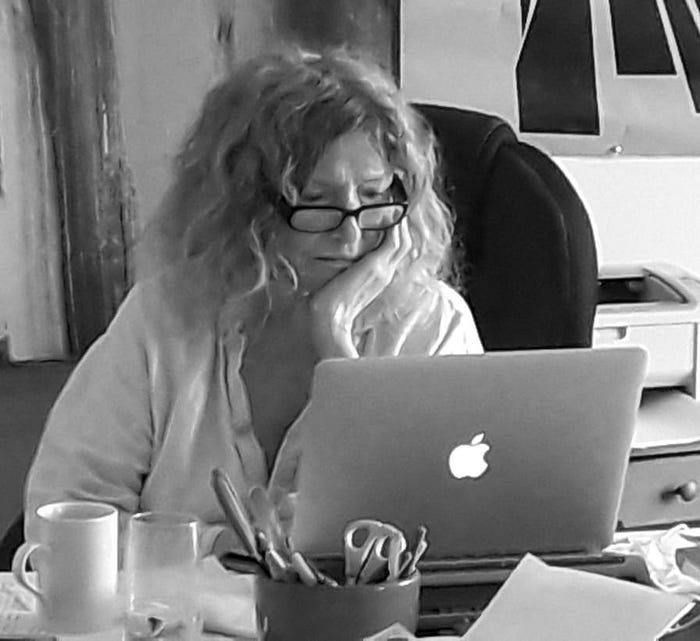
I recently had lunch with a group of women friends, one of those long, wine-fuelled, gossipy things where the conversation flows easily from one topic to another and carries on even as waiters remove plates and the restaurant empties.
It’s one of the joys of dining out in France, no hovering presence asking if you’re still “working on that. . .” (I loathe that phrasing; should eating be work?) or discreetly setting down the check, “Whenever you’re ready.” What if you won’t be ready for a week? Or ever? In France, there’s none of that. Ready to pay? Just wave down a waiter. You won’t be asked if the food was satisfactory; empty plates are answer enough. And tips appreciated, but not expected.
“So is this going to be a story?” the friend next to me whispered in the middle of a particularly salacious bit of village gossip. I laughed; she knows me well. In fact, while I hadn’t consciously thought about the lunch as story material, I realised that part of my brain, whatever part deals with that kind of stuff, was storing it away — a squirrelly scribbler hoarding acorns for future reference.
I’ve done it for as long as I can remember — at 81, that’s a lot of acorns. My daughter, now in her late fifties, was a teenager with a new driver’s license when I got the call every parent dreads. She was in the emergency room. “She’ll be ok,” the nurse soothed as I dissolved into incoherent sobs. And she was — until I wrote an op-ed piece about it later.
While trying to understand my own feelings about the accident, I’d unintentionally embarrassed her and invaded her privacy. “If I tell you something,” she said long after this offence and, I confess, a few others, “I don’t want you to write about it.”
We cannot silence the punishing, constantly assessing voice in our heads, the one that turns everything that happens, every encounter, every thought, every feeling into a referendum on our lives as a whole. It’s wearing to be perpetually taking your own mental temperature, to be always re-evaluating.Deborah Levy, Hot Milk
Levy, one of my favourite writers, blends memoir, novel, personal reflection and commentary into a hybrid mix she’s described as Living Autobiography. I’ve read most of her books, often wondering where her actual lived experience stops and fiction begins. But it’s a difficult thing to define.
To make a laughable comparison, the nine books I wrote for Harlequin were fiction. They followed Harlequin’s structure, guidelines, and feel-good endings. But most of them carried snippets — or acorns — gathered from my life. My public relations background, an irritating spouse, my equally irritating but unintentionally comic mother.
If I thought my fictional mum was a dead ringer and worried that my real mum would be offended, I needn’t have. She saw nothing of herself in my portrayal. Not even the scene, adapted from my journals, in which she’d practised driving her mobility scooter in the living room and crashed into a team of china Budweiser horses pulling tiny barrels of beer. One suffered a broken leg. My mum said the horses had no business being there.
Memories fade; by the time she read my book, she may have forgotten about the Budweiser bang-up.
I realise the unreliability of memories when I go through the journals that hold my acorn stash. Thirteen years after my move to France, for example, journal entries remind me that my early years in this country were often a bit lonely and not quite as exciting and adventurous as I remember them today.
Change is constant. An idea that seemed so compelling even a week ago seems less so today. Maybe I was angry then, and I’m not now. Or worried, or excited. With time comes perspective. Sometimes. As the late Queen Elizabeth famously remarked about Harry and Meghan’s TV sobathon, some recollections may vary. And by next week, my impressions gathered from yesterday’s lunch might well have changed.
But that’s the thing about writers and the narrator’s voice in our heads — the one obsessively on the alert for material, sorting through details, coming up with interpretations. It’s like a light that won’t turn off, and it’s exhausting.
And yet there’s something even more exhausting. The times when, despite the mental yammering, I sit down to write and, despite years of acorn gathering, my vast mental hoard refuses to yield a single idea. Infuriating and depressing; I fear the creative well may have dried up completely.
But, wait. Perhaps that, too, is story material.
And so it goes.
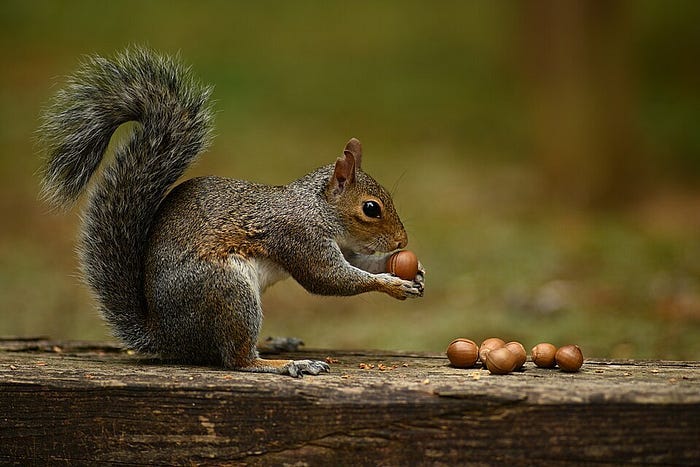
oh, I now realise I Am A Squirrel..... All my tales, stories, memory snippets, jokes, replies, comments, letters are acorns, some fleshed out, some half-dry, some small or big. They are all mine, they make ppl laugh, smile, think, I scatter them, with care, love, for fun, or hand them out, one by one, to friends who really need an acorn of 'whatever' (hope, help, love, info). I love what you do with your acorns and I try to make sure I'm not giving away mine, knowing that someone's feeling might be hurt, or giving a false impression, but I fear I did give away a few relating to ppl w/o any knowledge of the language(s) I write in.... hoping that I'll never hurt any feelings.
And so it goes indeed. Love your posts!